
Laboratory Techniques and Laboratory Assignment Measurements Answers
- Laboratory assignment Laboratory Techniques Answers
Hands-On Labs, Inc.
Version 42-0165-00-02
Lab Report Assistant
This is not intended to serve as a laboratory report. Lab Report Assistant is a brief summary of the questions, diagrams (when applicable) and data tables included in the experiment that should be answered for a formal lab report. The intent is to facilitate students’ writing of lab reports by providing this information in an editable file that can be sent to an instructor.
Measurements of length, temperature, and mass.
Exercise 1: Length, Temperature, and Mass
Data Table 1. Length Measurements.
| Object | Length (cm) | Length (mm) | Length (m) |
| CD or DVD | 18 cm | 180 mm | 0.18 m |
| Key | 5 cm | 50 mm | 0.05 m |
| Spoon | 21 cm | 210 mm | 0.21 m |
| Fork | 15 cm | 150 mm | 0.15 m |
Data Table 2. Temperature Measurements.
| Water | Temperature (°C) | Temperature (°F) | Temperature (K) |
| Hot from the tap | 34o C | 95o F | 308 K |
| Boiling | 97°C | 209°F | 367.15 K |
| Boiling for 5 minutes | 104°C | 218°F | 494 K |
| Cold from the tap | 16°C | 57°F | 287.15 K |
| Ice water – 1 minute | 11°C | 49°F | 282.15 |
| Ice water – 5 minutes | 5°C | 41°F | 278.15 K |
Data Table 3. Mass Measurements.
| Object | Estimated Mass (g) | Actual Mass (g) | Actual mass (kg) | |||||
| Pen or pencil | 7g | 9g | 0.009 kg | |||||
| 3 Pennies | 7.5 g | 7.5g | 0.0075 kg | |||||
| 1 Quarter | 4 g | 5.7g | 0.0057 kg | |||||
| 2 Quarters, 3 Dimes | 15 g | 18.2g | 0.0182 kg | |||||
| 4 Dimes, 5 Pennies | 20 g | 22.1 g | 0.0221 kg | |||||
| 3 Quarters, 1 Dime, 5 Pennies | 30 g | 32.6 | 0.0326 kg | |||||
| Key | 6.5 g | 7.4 | 0.0074 kg | |||||
| Key, 1 Quarter, 4 Pennies | 19.6 g | 23.1 | 0.0231 kg | |||||
Questions
- Water boils at 100°C at sea level. If the water in this experiment did not boil at 100°C, what could be the reason?
At sea level, the boiling point of water is 100 °C. If the water level is above sea level it will boil at a lower temperature due to lower pressures. When the surrounding air pressure is greater than sea level, the boiling temperature will be higher than 100°C.
- Two samples of water were heated at sea level – one boiled at 102°C and the other boiled at 99.2 °C – what is the percent error for each sample, relative to the theoretical sea level boiling point of 100.0°C?
The percentage error for the sample one that boils at 102 degrees Celsius is 2 per cent. For the second sample which boils at 99.2 degrees centigrade, the percent error is -0.8 percent.
Exercise 2: Volume and Density
Data Table 4. Liquid Measurements
| Mass A | Mass B | Mass B – A | ||||
| Liquid | Volume (mL) | Graduated Cylinder (g) | Graduated Cylinder withliquid (g) | Liquid (g) | Density g/mL | % Error |
| Water | 5.0 ml | 5.0 ml | 5.0 ml | 5.0 ml | 5.0 ml | 5.0 ml |
| Isopropyl alcohol | 19.4 g | 19.4 g | 19.4 g | 19.4 g | 19.4 g | 19.4 g |
Data Table 5. Magnet – Measurement Method.
| Object: | Mass (g) | Length (cm) | Width (cm) | Height (cm) | Volume (cm3) | Density (g/cm3) |
| Magnet | 4 g | 2.5 cm | 0.25 cm | 0.25 cm | 0.16 cm3 | 25 g/cm3 |
Data Table 6. Displacement Method.
| Object | Mass (g) | Initial volume of graduated cylinder (mL) | Final volume of graduated cylinder (mL) | Object Volume (mL) | Density (g/mL) |
| Magnet | 4 g | 8 ml | 10 ml | 2 ml | 2g/ml |
| Metal bolt | 7.6 g | 8 ml | 12 ml | 4 ml | 1.9g/ml |
Data Table 7. Archimedes’ method.
| Object | Mass (g) | Mass of Displaced Water (g) | Volume of Displaced Water (mL) | Density (g/mL) |
| Metal Bolt | 7.6 g | 117.5 g | 116.4 ml | 1.07g/ml |
| Magnet | 4 g | 117.1 g | 116.4 ml | 1.04 g/ml |
Questions
- n unknown rectangular substance has dimensions of 3.6 cm, 4.21 cm and 1.17 cm. Its mass is 21.3 g, what is the density (g/mL) of this substance?
** 1 gram = 1 cm 3.6 x 4.21 x 1.17 = 17.7 21.3g / 17.7mL = 1.2 g/mL The density is 1.2 g/mL
A sample of gold (Au) has a mass of 26.15 g. What is the volume of the gold sample made if the theoretical density of gold is 19.30 g/mL?
** Volume = Mass/Density Volume- 26.15 g /19.30 g/mL = 1.4 mL
- If the object had been dropped into the beaker using the Archimedes’ Principle method instead of the object being submerged and the water level recorded, what would be the results?
If the object was dropped in the beaker instead of the object being submersed in the water with the Archimedes’ Principle method. I believe I would get a result that was the same as the volume of the object, rather than a result based on the buoyancy.
- What were the comparisons between the measurement of the density (using Archimedes’ Principle) and the measurement of the density (using the calculated volume)? Which might be the more accurate method? Why?
** The density measurements are almost half. Archimedes’ Principle showed that the density of the magnet and the metal bolt seemed to be less. The displacement method seemed more accurate because I wasn’t holding the string to each object that I submerged it under. The possibility of human error is highly possible.
You have a small piece of gold-colored material and you’d like to know whether or not it is gold. By the Archimedes’ principle, you determine the volume to be 0.40 cm3 and the mass to be
6.0 g. What inferences can you make based on your straightforward density analysis?
First, I would measure the actual density of gold, which is 19.3 g/cm3 and then measure the density of it and compare it with the density of gold to check its authenticity. The numbers given for the gold colored object would make its density 15 g/cm3. My conclusion would be that the object is not made from gold as it is not a golden colour.
Exercise 3: Concentration, Solution, and Dilution
Data Table 8. Initial Concentration.
| Chemical | Mass ofVolumetric Flask | Mass of Sugar (g) | Molar Mass (g) | Moles in a Volumetric Flask | Total Volume (L) | Molarity (mol/L) |
| Sugar (C12H22O11) | 27.3 | 8 | 342.296 g | 0.079755 | 0.025 | 3.1902mol/L |
Data Table 9. Dilution Series.
| Dilution | Volume (mL) | Mass (g) | Density (g/mL) | Initial Concentration (M) | Volume Transferred (mL) | Final Concentration (M) |
| 0 | 25.0 mL | 27.7g | 1.108g/mL | 0 mL | 3.1902 M | |
| 1 | 25.0 mL | 24.9g | 0.996g/mL | 3.1902 M | 2.5 mL | 0.31902 M |
| 2 | 25.0 mL | 25.4g | 0.984g/mL | 3.1902 M | 4.5 mL | 1.741444 M |
| 3 | 25.0 mL | 25.1 | 1.004g/mL | 3.1902 M | 3.0 mL | 2.612166 M |
| 4 | 25.0 mL | 25.6 | 1.024g/mL | 3.1902 M | 6.0 mL | 1.306083 M |
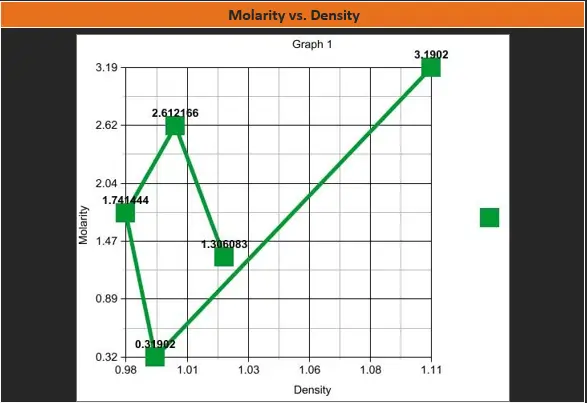
Data Table 10. Molarity vs. Density.
Questions
If 1M HCl solution was available, how would you make 10 mL of a 0.25M solution? How many mLs of 1M HCl will be required? How many millilitres of distilled water are used?
0.25M is 0.25 moles/L 0.25*10/1= 2.5 mL needed
- From the graph of Molarity vs. Density, created in Data Table 10, what was the relationship between the molarity of the sugar solution and the density of the sugar solution?
**As the sugar solution density decreased, the molarity decreased. Conversely, the same held true.